During a snow event
Winter maintenance priority order and timelines
Our snow clearing process follows a priority route system, which means some roads and sidewalks are cleared before others.
Each level of priority is listed below and details about timelines and service levels can be found by expanding each item.
We clear snow in the following order:
We clear the roads in the following order:
What are primary roadways?
- Roads with highest speeds.
- Roads with greatest volume of traffic.
- Examples: Trafalgar and Upper Middle Roads.
What to expect from our clearing team
- Salting starts when snow first accumulates.
- Clearing starts when accumulation meets 2.5 centimetres.
- Average time it takes to clear all main roadways is up to six hours after the snow stops falling.
- When service levels are met, in general you can expect bare pavement conditions.
What are Transit terminals and Ride On-Demand hubs?
Transit terminals and Ride On-Demand hubs include key Oakville Transit connection points and transfer locations. The Town is responsible for clearing the Uptown Core Terminal (Oak Walk & Taunton), Rebecca Hub (Hopedale Mall) and Leighland Hub (Oakville Place mall).
For more information, visit the Terminal & Station Maps page and the Ride On-Demand page.
What to expect from our clearing team
- Clearing starts when accumulation meets 2.5 centimetres.
- Average time it takes to clear all transit terminals and Ride On-Demand hubs is up to 24 hours after the snow stops falling.
- When service levels are met, in general you can expect bare pavement conditions and the road cleared from curb to curb.
What are secondary roadways?
- Roads with less traffic than primary roads but also have transit routes and school zones.
- Generally, lead to primary roads.
- Examples: Glenashton Drive and West Oaks Trails.
What to expect from our clearing team
- Salting starts when snow first accumulates.
- Clearing starts when accumulation meets 5 centimetres.
- Average time it takes to clear all secondary roadways is up to 12 hours after the snow stops falling.
- When service levels are met, in general you can expect bare pavement conditions and the road cleared from curb to curb.
What are primary sidewalks and applicable multi-use pathways?
- Sidewalks along primary roadways.
- A multi-use pathway (MUP) is a paved route shared by pedestrians, cyclists and people using personal mobility devices.
- In some areas MUP’s are located alongside primary roadways instead of a sidewalk making them eligible for regular snow clearing operations, snow clearing is completed to a width equivalent to a standard sidewalk, rather than the full width of the pathway. Note that when both sidewalk and MUP exists, only the sidewalk is plowed.
- Examples: Beryl Road and North Service Road from Dorval to Fourth Line.
What to expect from our clearing team
- Sanding starts when sidewalk conditions are deemed slippery.
- Clearing starts when accumulation meets 5 centimetres and after snowfall ends.
- It takes up to 24 hours after the snow stops falling to clear all primary sidewalks.
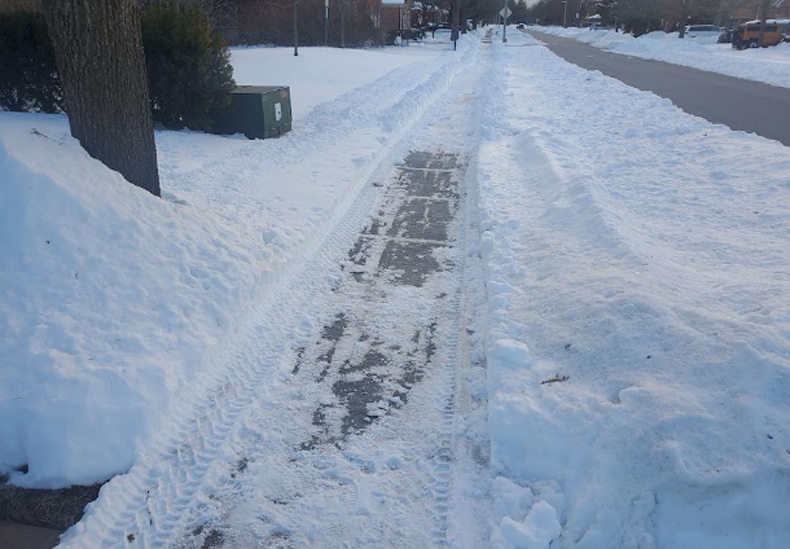
- When service levels are met, in general you can expect snowpack pavement conditions.
What are secondary sidewalks?
- Sidewalks along secondary roadways.
- Some seemingly residential sidewalks are classified as secondary due to the presence of bus routes, school zones or generally lead to primary roads.
- Examples: Glenashton Drive and West Oaks Trails
What to expect from our clearing team
- Sanding starts when sidewalk conditions are deemed slippery.
- Clearing starts when accumulation meets 5 centimetres, snowfall ends and primary sidewalks are completed.
- Average time it takes to clear all secondary sidewalks is up to 24 hours after the snow stops falling.
- When service levels are met, in general you can expect snowpack pavement conditions.
What are transit stops?
- Transit stops are designated locations where Oakville Transit buses pick up and drop off passengers. They may include a bus stop sign, shelter, bench, sidewalk connection or paved waiting area beside the road.
What to expect from our clearing team
- Sanding starts when transit stop conditions are deemed slippery.
- Clearing starts when accumulation meets 5 centimetres, after snowfall ends and the adjacent roadway clearing is complete.
- Average time it takes to clear all transit stops is up to 48 hours after the snow stops falling.
- When service levels are met, in general you can expect snowpack pavement conditions.
What are residential roadways and laneways?
- Local roads and laneways with much less traffic than primary or secondary roadways.
- Some seemingly residential roads may be classified as secondary due to high traffic volumes, the presence of facilities such as schools or transit stops.
- Examples: George Street and William Street.
What to expect from our clearing team
- Sanding starts when roadway conditions are deemed necessary.
- Clearing starts when accumulation meets 7.5 centimetres and after snowfall ends.
- Average time it takes to clear all residential roadways/laneways is up to 24 hours after the snow stops falling.
- When service levels are met, in general you can expect snowpack conditions with the road cleared to allow one vehicle per one travelled lane in each direction.
- Plow operators do not intentionally block driveways with windrows. The plow operator has limited control over the amount and direction of snow that comes off the plow.
What is driveway windrow snow clearing?
- The Town offers a paid windrow snow clearing program (1,100 homes) to help residents clear the snow left at the base of their driveways by snowplows.
- For more information visit the Driveway Windrow Snow Clearing page.
What to expect from our clearing team
- Windrow clearing operations do not begin until accumulation meets 7.5 centimetres, after snowfall ends and residential roadway clearing is complete.
- Average time it takes to clear all residential driveway windrows is up to 36 hours after the snow stops falling.
- When services levels are met in general you can expect snow pack conditions and 80 per cent of driveway width cleared (entrance 1 car length width to approximately 3 metres).
- For more information visit the Driveway Windrow Snow Clearing page.
What are residential sidewalks?
- Sidewalks along residential roadways.
- Examples: King Street and Front Street
What to expect from our clearing team
- Sanding starts when sidewalk conditions are deemed slippery.
- Clearing starts when accumulation meets 8 centimetres, after snowfall ends and primary and secondary sidewalks are completed.
- The average time it takes to clear all residential sidewalks is up to 48 hours after the snow stops falling.
- When service levels are met, in general you can expect snowpack pavement conditions.
Understanding snow clearing priorities
Snow clearing priority levels are based on how a road functions in the overall road system. Some roads are main travel routes, while others lead to homes. Main roads are cleared more fully because they carry more traffic and higher speeds. Residential roads are used at lower speeds and may be left with snow pack conditions.
Different priority levels of roads are cleared with different equipment, so crews working on primary/secondary roads cannot always clear nearby residential streets at the same time.
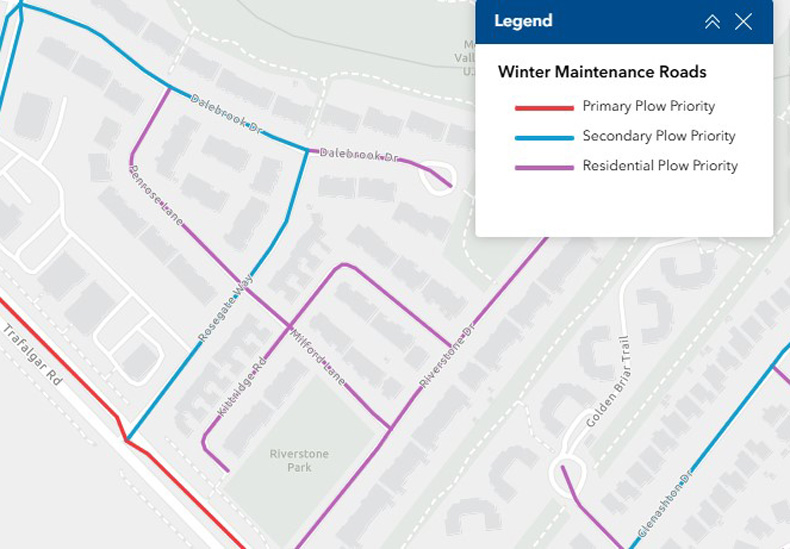
Occasionally, sections of roads can transition from one priority level to another (ex: Dalebrook Drive).
Road conditions may also look different after a storm. This helps keep roads safe, use equipment wisely, and reduce salt use to protect the environment.
After the plows are finished
Roads and sidewalks won't always be cleared to bare pavement
To achieve bare roads and sidewalks, salt must be applied at the onset of snow so that a layer of salt brine is maintained between the road surface and accumulating snow to prevent bonding.
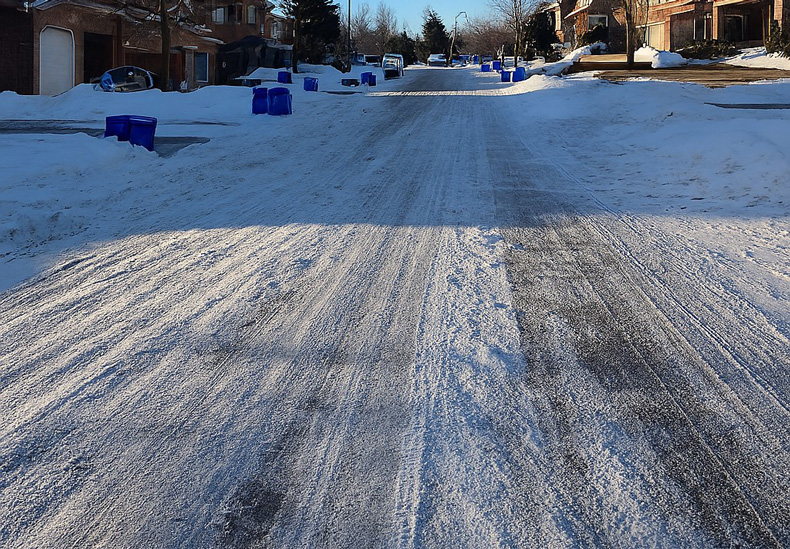
- To provide this level of service to residential roads, significant increases in equipment and salt would be required, with increased costs and environmental impact.
- Oakville, as well as other Canadian road agencies, are required to have a Salt Management Plan to manage salt use and minimize environmental impacts.
- Aside from Business Improvement Areas (Downtown, Kerr Street, Bronte), sidewalks are only plowed.
Expect "snow pack" on residential roads, laneways and sidewalks
Snow pack is hard-packed snow on a roadway. It can be expected periodically on residential roads.
- Snow pack develops quickly as vehicles travel on snow-covered roads.
- Snow plows are unable to scrape off snow pack as it is usually bonded to the pavement.
- Although bumpy at times, vehicles typically navigate snow pack quite easily.
- Under snow pack conditions, some rutting can be expected.
- Our Roads and Works team will take steps to improve conditions when warranted.
- It would be unusual for a municipality that is subject to winter conditions, such as Oakville, to consider a snow pack unacceptable for local residential roads.
Lawn and sod damage
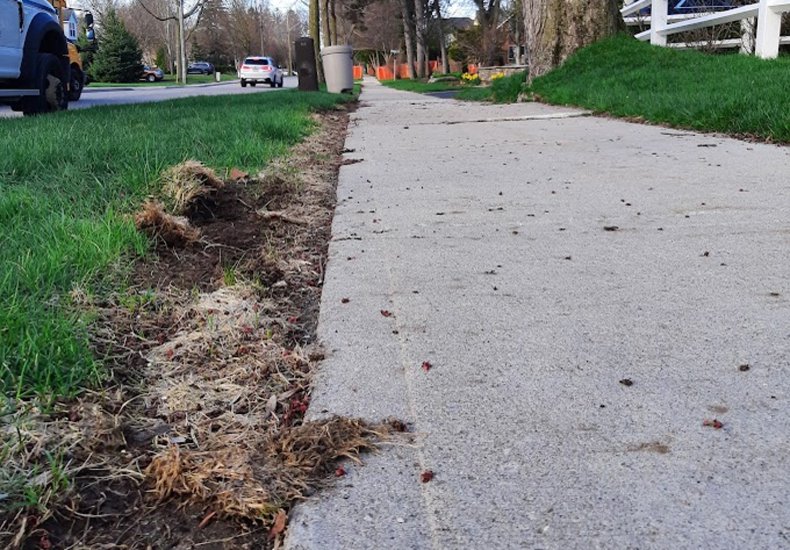
Plow operators try to minimize sod damage, but some degree of damage is inevitable.
- Sidewalk plows must be large machines to effectively plow deep snow. This makes them less forgiving to operate on sidewalks.
- Deep or drifted snow conditions often completely hide the sidewalk edge.
- When sod is frozen, damage is minimized; however, when sod is not frozen, it lifts away easily and damage can be extensive.
- Often, the sod removed is overgrowth growing onto the sidewalk.
- To report sod damage, please visit the Winter Services report a problem page. Sod damages reported before May 15 of each year, will be added to the list of inspection/repairs for completion by the end of May. If reported later, repairs may be rescheduled for the next winter season.
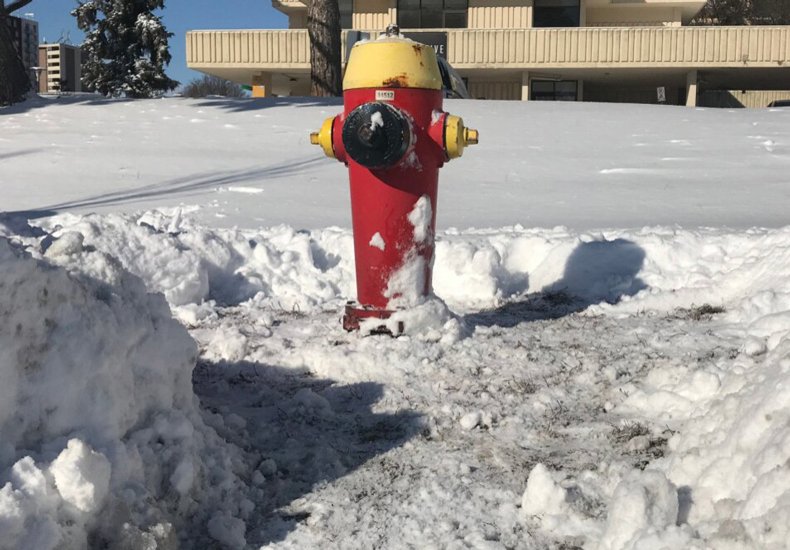
Fire hydrants
Every second counts during an emergency!
- If you can, please help Oakville Fire by keeping at least one metre clearance around hydrants in all directions near your home or business.
- If you require assistance, please contact Halton Region by calling 311.
Keeping you informed about snow clearing progress
During snow clearing operations we will keep you informed about our snow clearing progress by:
- Updating our Snow Clearing page
- Sharing information on Town of Oakville Facebook, Instagram and X social media accounts.
- Including snow messaging on our phone lines at 905-845-6601
- Posting the latest snow clearing news to our website
- Sending e-Alerts to your inbox, if you register for Town news notifications
- Posting weather related service updates to our website, if applicable
Contact us
Contact information
Get additional information by contacting ServiceOakville.
Phone: 905-845-6601
TTY: 905-338-4200